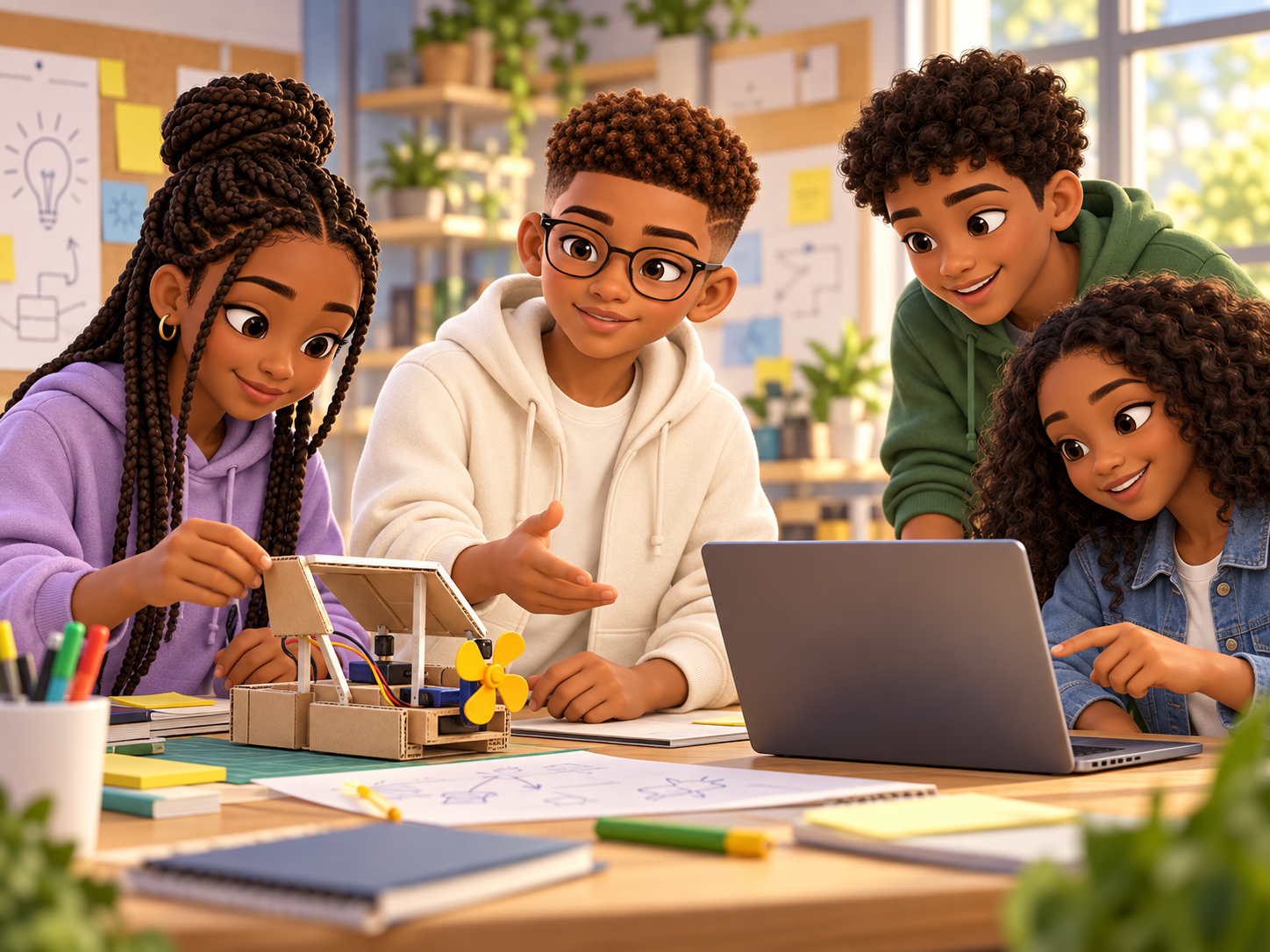
Build something you can test, explain, and improve.
Flowst Projects is being developed for young people, especially junior and senior secondary learners, to strengthen practical thinking through making. Each challenge leads toward a physical product, digital product, or a project combining both.
- Learn concepts through practical decisions
- Turn knowledge into something usable
- Build confidence through testing and iteration
Make progress one useful step at a time.
Each project begins with a purposeful challenge and moves through a structured building process. Learners remain responsible for the ideas, decisions, and finished work.
- 01
Meet the challenge
Begin with a problem or opportunity worth exploring.
- 02
Understand the problem
Investigate the people, context, needs, and constraints involved.
- 03
Shape an idea
Compare possible directions and choose what to develop.
- 04
Plan the build
Define the outcome, tools, materials, tasks, and checkpoints.
- 05
Make a first version
Create a model, prototype, draft, or working product.
- 06
Test it
Observe what works and where the product falls short.
- 07
Improve it
Use evidence and feedback to revise the work.
- 08
Present the product
Explain the decisions, process, result, and learning.
Guidance for the next useful step.
Nyles is being built to help learners understand a challenge, organize their ideas, plan the work, choose suitable tools or materials, document progress, test what they make, and decide what to improve next. His role follows a clear rhythm: Imagine, Plan, Build, Improve.
- Break ambitious projects into achievable stages
- Keep research, plans, decisions, and revisions connected
- Ask questions and offer guidance without taking over the work
More than one way to build.
Challenges can lead to apps, websites, games, media, models, prototypes, devices, growing projects, designed objects, or practical responses to needs in a learner's community. These examples show the range being explored rather than a fixed challenge catalogue.
- Build a physical product
- Create a digital product
- Combine physical and digital ideas
Young people do the building. People keep responsibility.
Nyles can guide the process, but he does not operate equipment, approve physical safety, or build the product for the learner. Appropriate adults, teachers, mentors, or specialists review materials and supervise activities involving tools or real-world risk.
- Learners retain creative ownership
- Tools and materials require appropriate approval
- Physical work receives suitable human supervision